6 Years of Symptom Control: Learn how Joe saw movement improvement and seamlessly switched from AUSTEDO to one pill, once-daily AUSTEDO XR.
Onscreen text:
TD
6 YEARS OF SYMPTOM CONTROL
JOE’S JOURNEY WITH TD TREATMENT
Primary conditions: bipolar disorder and depression
Disclaimer at bottom of screen:
This was an individual patient’s experience. Results may vary. Participant was compensated by Teva Pharmaceuticals.
TD, tardive dyskinesia.
Joe:
My name is Joe. I was diagnosed with bipolar back in 2008…I suffered from depression before that…and sometimes I would just stay in bed or just hide out in the house and wouldn't do anything.
And so, I've been on many different medications…
On-screen text:
Joe had been taking mental health medication for 5 years when he began experiencing involuntary movements.
Joe:
I started having mouth movements that were uncontrollable…
I would be like I was talking, but I wasn't saying anything. My mouth would just move by itself.
I was biting the inside of my cheek, and I was biting my tongue, and I was constantly moving my mouth, and it caused great stress and irritation.
It was keeping me awake at night, too.
And so, I knew I had to do something. I didn't know what it was at the time.
On-screen text:
After living with uncontrollable movements for a year, Joe finally decided to talk to his doctor.
Joe:
As soon as I sat down with him and he saw my mouth move, he knew right away that it was TD.
It was a major relief because it was like, so I finally know what’s wrong.
Onscreen text:
In 2019, Joe’s doctor started him on AUSTEDO.
Onscreen Indication and Black Box Warning:
AUSTEDO XR® and AUSTEDO® are indicated in adults for the treatment of chorea associated with Huntington’s disease and for the treatment of tardive dyskinesia.
IMPORTANT SAFETY INFORMATION
Depression and Suicidality in Patients with Huntington’s Disease: AUSTEDO XR and AUSTEDO can increase the risk of depression and suicidal thoughts and behavior (suicidality) in patients with Huntington’s disease. Balance the risks of depression and suicidality with the clinical need for treatment of chorea. Closely monitor patients for the emergence or worsening of depression, suicidality, or unusual changes in behavior. Inform patients, their caregivers, and families of the risk of depression and suicidality and instruct them to report behaviors of concern promptly to the treating physician. Exercise caution when treating patients with a history of depression or prior suicide attempts or ideation. AUSTEDO XR and AUSTEDO are contraindicated in patients who are suicidal, and in patients with untreated or inadequately treated depression.
Please see additional Important Safety Information at the end of this video.
Joe:
After taking AUSTEDO, I noticed that my mouth wasn't moving as much.
People around me did see the difference.
Onscreen text:
In pivotal studies, patients like Joe saw significant reduction of TD severity at Week 12.
Onscreen text:
3 YEARS of results
Sustained results through 3 years observed in TD patients with mood disorders (open-label extension study).*
Footnote at bottom of screen:
*Post hoc subgroup analysis.
Onscreen text:
Managing bipolar disorder can be complicated.
But even with mental health medication changes over the years, Joe has been able to stay on AUSTEDO.
Joe:
The thing with mental health drugs is…sometimes you have to change your medication…Right now I’m in the healthy stage, so we have this regimen that works. But when I’m in a crisis, we have to increase it.
AUSTEDO works with my mental health drugs. They coincide well with each other.
I was so glad that I was able to stay on AUSTEDO.
Onscreen text:
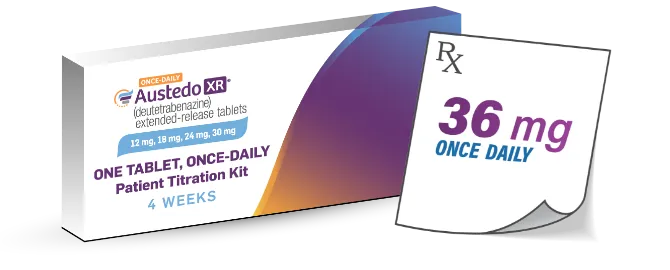
When one pill, once-daily AUSTEDO XR became available in 2024, Joe was able to make the switch seamlessly.
Onscreen text:
In a survey of 209 patients with TD taking AUSTEDO XR, 99% said taking AUSTEDO XR was easy.
Joe:
I would recommend if you go on AUSTEDO to take the extended release. It’s much easier…taking the pill once a day, rather than having to take it twice a day.
Onscreen text:
6 years after starting AUSTEDO, Joe continues to see movement control.
Onscreen text:
AUSTEDO XR has not been shown to affect the outcomes mentioned.
Joe:
Without it I wouldn’t be the same, I wouldn’t be able to function every day without the AUSTEDO.
…it just makes me be able to go live a normal life without having to deal with the mouth movements.
TD may change your life, but AUSTEDO can help make it better.
Onscreen text:
How can AUSTEDO XR make a difference for your patients?
Learn more at AUSTEDOhcp.com
Onscreen ISI scroll:
INDICATIONS AND USAGE
AUSTEDO XR and AUSTEDO are indicated in adults for the treatment of chorea associated with Huntington’s disease and for the treatment of tardive dyskinesia.
IMPORTANT SAFETY INFORMATION
Depression and Suicidality in Patients with Huntington’s Disease: AUSTEDO XR and AUSTEDO can increase the risk of depression and suicidal thoughts and behavior (suicidality) in patients with Huntington’s disease. Balance the risks of depression and suicidality with the clinical need for treatment of chorea. Closely monitor patients for the emergence or worsening of depression, suicidality, or unusual changes in behavior. Inform patients, their caregivers, and families of the risk of depression and suicidality and instruct them to report behaviors of concern promptly to the treating physician. Exercise caution when treating patients with a history of depression or prior suicide attempts or ideation. AUSTEDO XR and AUSTEDO are contraindicated in patients who are suicidal, and in patients with untreated or inadequately treated depression.
Contraindications: AUSTEDO XR and AUSTEDO are contraindicated in patients with Huntington’s disease who are suicidal, or have untreated or inadequately treated depression. AUSTEDO XR and AUSTEDO are also contraindicated in: patients with hepatic impairment; patients taking reserpine or within 20 days of discontinuing reserpine; patients taking monoamine oxidase inhibitors (MAOIs), or within 14 days of discontinuing MAOI therapy; and patients taking tetrabenazine or valbenazine.
Clinical Worsening and Adverse Events in Patients with Huntington’s Disease: AUSTEDO XR and AUSTEDO may cause a worsening in mood, cognition, rigidity, and functional capacity. Prescribers should periodically re-evaluate the need for AUSTEDO XR or AUSTEDO in their patients by assessing the effect on chorea and possible adverse effects.
QTc Prolongation: AUSTEDO XR and AUSTEDO may prolong the QT interval, but the degree of QT prolongation is not clinically significant when AUSTEDO XR or AUSTEDO is administered within the recommended dosage range. AUSTEDO XR and AUSTEDO should be avoided in patients with congenital long QT syndrome and in patients with a history of cardiac arrhythmias.
Neuroleptic Malignant Syndrome (NMS), a potentially fatal symptom complex reported in association with drugs that reduce dopaminergic transmission, has been observed in patients receiving tetrabenazine. The risk may be increased by concomitant use of dopamine antagonists or antipsychotics. The management of NMS should include immediate discontinuation of AUSTEDO XR and AUSTEDO; intensive symptomatic treatment and medical monitoring; and treatment of any concomitant serious medical problems.
Akathisia, Agitation, and Restlessness: AUSTEDO XR and AUSTEDO may increase the risk of akathisia, agitation, and restlessness. The risk of akathisia may be increased by concomitant use of dopamine antagonists or antipsychotics. If a patient develops akathisia, the AUSTEDO XR or AUSTEDO dose should be reduced; some patients may require discontinuation of therapy.
Parkinsonism: AUSTEDO XR and AUSTEDO may cause parkinsonism in patients with Huntington’s disease or tardive dyskinesia. Parkinsonism has also been observed with other VMAT2 inhibitors. The risk of parkinsonism may be increased by concomitant use of dopamine antagonists or antipsychotics. If a patient develops parkinsonism, the AUSTEDO XR or AUSTEDO dose should be reduced; some patients may require discontinuation of therapy.
Sedation and Somnolence: Sedation is a common dose-limiting adverse reaction of AUSTEDO XR and AUSTEDO. Patients should not perform activities requiring mental alertness, such as operating a motor vehicle or hazardous machinery, until they are on a maintenance dose of AUSTEDO XR or AUSTEDO and know how the drug affects them. Concomitant use of alcohol or other sedating drugs may have additive effects and worsen sedation and somnolence.
Hyperprolactinemia: Tetrabenazine elevates serum prolactin concentrations in humans. If there is a clinical suspicion of symptomatic hyperprolactinemia, appropriate laboratory testing should be done and consideration should be given to discontinuation of AUSTEDO XR and AUSTEDO.
Binding to Melanin-Containing Tissues: Deutetrabenazine or its metabolites bind to melanin-containing tissues and could accumulate in these tissues over time. Prescribers should be aware of the possibility of long-term ophthalmologic effects.
Common Adverse Reactions: The most common adverse reactions for AUSTEDO (>8% and greater than placebo) in a controlled clinical study in patients with Huntington’s disease were somnolence, diarrhea, dry mouth, and fatigue. The most common adverse reactions for AUSTEDO (4% and greater than placebo) in controlled clinical studies in patients with tardive dyskinesia were nasopharyngitis and insomnia. Adverse reactions with AUSTEDO XR extended-release tablets are expected to be similar to AUSTEDO tablets.
Please see full Prescribing Information, including Boxed Warning, at AUSTEDOhcp.com.









 Request a rep